

In the quiet, gated streets of Whisper Rock in Scottsdale’s 85266 ZIP code, many older adults value one thing above almost everything else: the ability to stay in control of their daily life. Yet as joints wear out, hearts work harder, and lungs grow more fragile, imaging tests like X-rays become unavoidable. The challenge is how to get those tests done without turning every new symptom into an exhausting trip across town.
Dr. Rebecca Cook, a board-certified geriatrician, solves that problem by partnering with HCI Radiology, a mobile imaging company that has specialized in bedside diagnostics across Arizona and Texas for decades.
Together, they bring hospital-grade X-rays and other tests into the homes of Whisper Rock residents so health questions can be answered without leaving the comfort and privacy of the community.
Whisper Rock: Independence Meets Distance From Hospitals
Whisper Rock offers large lots, desert views, and a strong sense of privacy. Those same qualities, however, mean that most homes sit a long drive away from major hospitals or imaging centers. For many residents, getting an X-ray is not just a quick errand.
A single “simple” clinic visit can involve:
-
Arranging transportation or asking family to take off work
-
Passing through security gates multiple times
-
Dealing with parking, check-in, and waiting rooms full of sick people
-
Managing pain, balance issues, or confusion in unfamiliar hallways
For someone recovering from orthopedic surgery, living with arthritis, or coping with memory decline, that experience can feel like a loss of control. The idea behind home imaging is to reverse that dynamic: keep the person in charge, and let the equipment move instead.

What HCI Radiology Actually Brings Into the Home
HCI Radiology (HealthCare Imaging) is a full-service mobile radiology organization that provides digital X-ray, diagnostic ultrasound, echocardiograms, and EKG/ABI testing at the bedside. The company has operated since the late 1990s and now serves patients across Arizona and Texas, including homebound individuals and residents of assisted living and long-term care facilities.
Their technologists arrive with compact equipment and a digital workflow built on secure PACS technology, which allows images to be transmitted and read remotely by radiologists and cardiologists.
For a Whisper Rock household, that usually means three core services.
Digital X-rays for Bones and Lungs
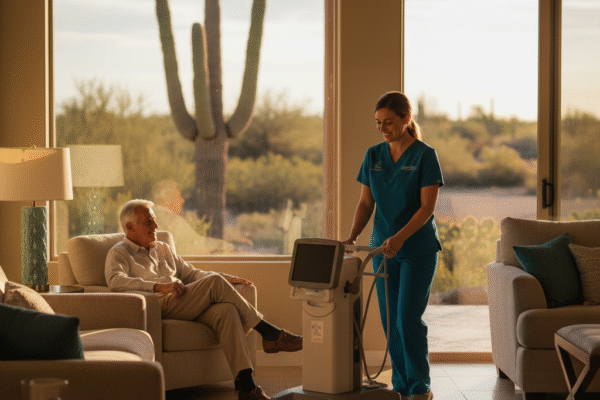
Portable digital X-ray units roll through the front door and can be set up in a bedroom, den, or casita. The technologist positions the plate behind the area of concern—hip, chest, spine, or ankle—and takes the images in a few quick exposures.
Doctors commonly order these home X-rays to:
-
Confirm or rule out fractures after a fall
-
Check for pneumonia or bronchial infections
-
Monitor arthritis or bone density changes
-
Assess healing after orthopedic surgery
The images are then uploaded through HCI’s secure system for a board-certified radiologist to interpret.
Ultrasound for Soft-Tissue Questions
HCI also offers portable ultrasound exams. These are especially helpful when older adults describe abdominal discomfort, new leg swelling, or changes in existing cysts or masses. Technologists can perform abdominal, vascular, or thyroid studies at the bedside and send the recordings to specialists for review.
For Whisper Rock residents, ultrasound at home means no long car rides while fasting, no waiting rooms, and far less disruption to routines.
EKG and Cardiac Testing
When symptoms point toward the heart—palpitations, new shortness of breath, or unexplained weakness—HCI technologists can perform a 12-lead EKG in the home as well. The tracing is transmitted to physicians trained in cardiac interpretation, and in more complex cases echocardiograms or ABI studies can be arranged through the same mobile platform.
This allows Dr. Cook to quickly decide whether a change in symptoms reflects something that can be managed at home, or whether it signals a need for higher-level care.
Inside a Home X-Ray Visit in Whisper Rock
1. Dr. Cook Evaluates the Problem
A new concern—like pain after a stumble, a deeper cough, or swelling in a leg—triggers a house call or telehealth assessment. Dr. Cook reviews the story, examines the patient if she is on site, and determines whether imaging will change the plan.
2. Order Sent to HCI Radiology
Once she decides an X-ray or ultrasound is needed, Dr. Cook sends a detailed order to HCI Radiology with the clinical question, the exact body part, and any special precautions.
3. Scheduling Around Gated Access
4. The Technologist Visit
5. Image Transmission and Specialist Reading
6. Follow-Up with Dr. Cook
How Dr. Cook Uses HCI Results to Protect Independence
Dr. Cook’s role goes far beyond simply ordering an X-ray. She uses the data from HCI Radiology to make decisions that directly affect how long an older adult can safely remain at home in Whisper Rock.
Depending on the findings, she might:
-
Change a mobility plan—adding a walker, arranging grab bars, or recommending short-term physical therapy
-
Adjust medications to address inflammation, bone health, or fluid overload
-
Coordinate with orthopedic surgeons, pulmonologists, or cardiologists when specialized follow-up is needed
-
Revisit home safety, fall risks, and goals of care with the family
Because she already knows the home environment, these decisions feel less abstract and more practical. The question is never just “What does the X-ray show?” but “What needs to change in this house, with this person, to keep them safe?”

Why Whisper Rock Residents Choose Home Imaging
Privacy
Sensitive health issues are discussed in the living room, not at a crowded front desk.
Security
Fewer outside trips mean fewer late-night drives and fewer moments of vulnerability in parking lots or elevators.
Continuity
The same doctor who knows the patient’s history, medications, and preferences stays in charge of the workup.
Energy Conservation
Instead of spending a whole afternoon traveling to and from an imaging center, older adults can rest, hydrate, and recover while the technologist comes to them.
Families also benefit. They are not constantly rearranging work schedules, coordinating rides, or navigating check-in systems. Their main job becomes being present during the exam and helping with small comforts—water, pillows, and reassurance.
When Home Imaging Helps—and When the ER Is Still Necessary
It is important to be clear about limits. Mobile X-rays and ultrasounds are powerful tools, especially when symptoms are worrisome but stable. They can answer questions like:
-
Is that cough turning into pneumonia?
-
Did this fall cause a fracture?
-
Is this swelling related to a clot or something else?
However, there are moments when no one should wait for a home visit. Sudden crushing chest pain, signs of stroke, severe difficulty breathing, or major trauma still require immediate emergency care. In those cases, Dr. Cook typically advises calling emergency services right away.
The strength of the Whisper Rock model lies in everything that happens before and after those emergencies: spotting problems earlier, clarifying what is going on, and adjusting care while the person is still comfortable at home.
Taking the Next Step in 85266
For older adults in Whisper Rock, autonomy does not have to disappear when health becomes more complicated. With HCI Radiology’s mobile imaging platform and Dr. Cook’s geriatric expertise, X-rays and other key tests can be done in a way that respects privacy, guards energy, and keeps decision-making close to home.
If you are wondering whether a home X-ray or ultrasound could help in your situation, starting the conversation is simple. You can reach out to Dr. Cook’s office, describe what has changed—pain, breathing, swelling, or recovery after a procedure—and ask whether a home-based evaluation with HCI Radiology support is appropriate. From there, a plan can be built around one core idea: your loved one’s independence in Whisper Rock is worth protecting.
