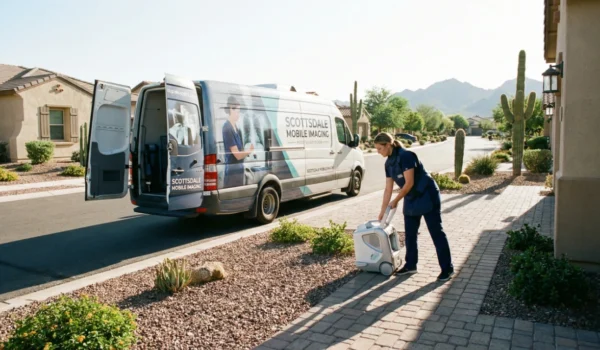
Mobile x-ray services in Scottsdale provided by HCI Imaging are a specialized form of bedside diagnostic care where high-tech medical imaging equipment is brought directly to a patient’s residence or care facility. The service works by deploying a licensed radiologic technologist with a portable digital radiography unit to the patient’s location, performing the scan on-site, and transmitting the images via a secure DICOM-compliant cloud network for immediate review by a board-certified radiologist. This allows the referring physician to receive a final diagnostic report, often within 60 minutes, without the patient ever leaving their home.
Dr. Rebecca Cook, M.D., is a board-certified internist and geriatrician with over 30 years of experience serving the Scottsdale and Greater Phoenix area. She witnesses daily how the stress and physical toll of hospital transport can negatively impact a patient’s recovery process. Through her collaboration with HCI Imaging, she facilitates access to critical diagnostic tools, such as bedside x-rays, for seniors and homebound neighbors who require professional medical imaging in a comfortable, safe environment. Dr. Cook is available to coordinate this high-level clinical care to ensure her patients receive timely and accurate diagnoses without the trauma of a hospital visit.
The Evolution of Portable Imaging Technology
The effectiveness of mobile x-ray services in Scottsdale is rooted in the shift from traditional analog film to modern Digital Radiography (DR). Unlike older systems that required physical plates to be developed in a lab, DR systems use flat-panel detectors that convert x-ray photons into digital data instantaneously.
The use of this technology by HCI Radiology offers several distinct advantages:
-
Immediate Image Verification: Technologists can confirm the quality of a scan on a tablet immediately, eliminating the need for repeat visits due to poor image quality.
-
Enhanced Detail: Digital sensors provide superior clarity, which is essential for detecting hairline fractures or subtle fluid changes in the lungs.
-
Reduced Radiation: Modern DR panels are highly sensitive, often requiring significantly lower radiation doses compared to traditional mobile units.
-
Compact Maneuverability: Modern units, such as the GE AMX-4 or lightweight DPX systems, are designed to navigate the tight hallways and small bedrooms typical of private residences and assisted living facilities.
Operational Workflow: The HCI Imaging Process
The coordination of a mobile exam follows a precise medical and technological protocol to ensure accuracy and speed:
-
Clinical Order: A healthcare provider, such as Dr. Rebecca Cook, submits an exam order through a secure portal.
-
Dispatch: A licensed technologist is sent to the Scottsdale or Phoenix residence with the necessary portable equipment.
-
On-Site Procedure: The technologist performs the scan at the bedside. The equipment is versatile enough to image the chest, spine, abdomen, or extremities while the patient remains in their own bed or chair.
-
Digital Transmission: Images are uploaded via the MediMatrix platform, a specialized system designed for streamlining mobile imaging workflows.
-
Radiological Interpretation: A board-certified radiologist reviews the high-resolution images via a secure, DICOM-compliant network.
-
Rapid Reporting: A formal report is generated and sent to the referring physician, often in under an hour for urgent cases.
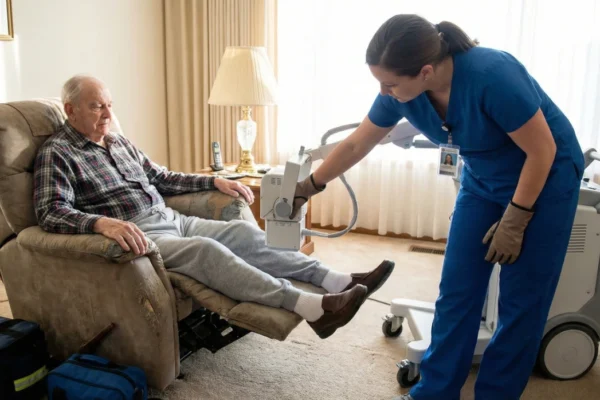
Clinical Necessity for Homebound Patients
Respiratory and Infection Monitoring
Diagnostic speed is critical for respiratory issues. Services include:
-
Pneumonia Screening: Detecting fluid or infection in the lungs early to prevent hospitalization.
-
COVID-19 Management: Using a covid chest x ray to monitor viral pneumonia without exposing the patient or the public to further infection in a clinic setting.
-
Congestive Heart Failure (CHF): Monitoring for pleural effusion to adjust medications proactively.
Post-Fall Assessment and Orthopedics
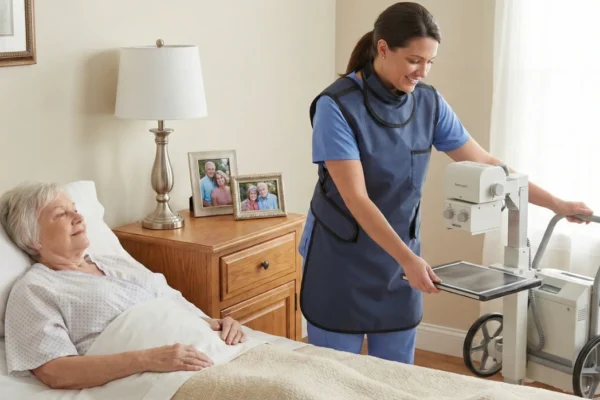
Falls are a primary concern for Scottsdale’s aging population. Mobile imaging allows for:
-
Fracture Rule-Out: Assessing the hip, pelvis, or femur immediately after a fall to determine if surgery is required.
-
Bedside Stability: Performing scans while the patient is stabilized in bed, reducing the risk of further injury during transport.
Support for Specialized Care
Beyond standard x-rays, HCI Radiology offers expanded mobile ultrasound services and mobile echocardiograms to monitor cardiac health and internal organ function without requiring the patient to leave their home.
Regulatory Compliance and Safety in Arizona
Mobile radiology in Arizona is strictly governed to ensure patient and public safety. HCI Imaging operates under the rigorous standards set by the Arizona Department of Health Services (ADHS) Bureau of Radiation Control.
-
Standardized Procedures: Technologists follow Arizona Administrative Code R9-7-604, which outlines the general procedures for safe radiation use.
-
Equipment Certification: All portable units must be registered and inspected to ensure they meet the specific standards for mobile machines.
-
Shielding and Distance: Operators use specific shielding techniques and maintain safety distances to ensure that radiation levels in a residential bedroom remain as safe as in a controlled hospital environment.
-
Data Privacy: All patient information is protected under the HIPAA Security Rule, utilizing secure storage and transmission methods.
Medicare and Economic Benefits
A significant advantage of in-home x-rays in Scottsdale is the clear financial and logistical benefit for patients and the healthcare system.
-
Medicare Part B Coverage: Medicare typically covers x-rays and the associated professional fees when ordered by a physician.
-
Transportation Reimbursement: Medicare recognizes the cost of bringing equipment to the home, utilizing specific reimbursement fees for transportation (codes R0070 and R0075).
-
Cost Offsets: By utilizing mobile services, patients avoid the high costs of non-emergency medical transport (NEMT) or ambulance services, which can cost hundreds of dollars per trip in Scottsdale.
Service Area: Local Support for Scottsdale Residents
Dr. Rebecca Cook and the HCI Imaging team focus their efforts on ensuring that high-quality diagnostic care is available across the major zip codes of Scottsdale: 85250, 85251, 85254, 85255, 85257, 85258, 85259, 85260, 85262, 85266.
Whether a patient resides in a private home in North Scottsdale or a senior living community in McCormick Ranch, this local coverage ensures that help is never far away.
Comparison: Mobile Radiology vs. Traditional Facilities
| Feature | Scottsdale Hospital / ER | HCI Mobile Imaging |
| Location | Requires patient travel | Patient’s own bedside |
| Wait Time | Often 4–6+ hours | Results within 60 mins |
| Infection Risk | High (waiting rooms) | Minimal (home environment) |
| Patient Comfort | Hospital gown / Hard table | Patient’s own bed / chair |
| Technology | Fixed X-Ray Units | Portable Digital DR Panels |
The Impact on Families and Caregivers
The “sandwich generation” in Scottsdale—adult children managing their own lives while caring for aging parents—finds immense relief in mobile x ray services.
-
Reduced Caregiver Burnout: Eliminates the need to take a full day off work to transport a parent to a medical complex.
-
Stability for Dementia Patients: Prevents the agitation and confusion that often occur when a memory-care patient is moved to an unfamiliar hospital setting.
-
Continuity of Care: Ensures that the diagnostic results go directly to the patient’s primary physician, like Dr. Rebecca Cook, who has a complete understanding of the patient’s medical history.
Frequently Asked Questions
Is a doctor's order required for a mobile x-ray?
Yes. All mobile radiology services must be ordered by a licensed healthcare provider, such as Dr. Rebecca Cook, to ensure medical necessity and proper follow-up care.
Are portable x-ray machines as accurate as those in hospitals?
Yes. Modern digital radiography units used by HCI Radiology are highly reliable and accurate, providing the same diagnostic quality as stationary machines found in major medical centers.
What preparation is needed at home?
Very little is required. The technologist only needs a clear path to the patient and access to a standard electrical outlet. The process is designed to be as non-intrusive as possible.
How do I schedule an exam?
Patients or caregivers can work with their physician to submit a request, or contact HCI Radiology directly to facilitate the ordering process.
Are you or a loved one in need of home-based medical support in Scottsdale?
Dr. Rebecca Cook’s practice is dedicated to patients in the 85250–85266 zip codes who require personalized attention and home-coordinated diagnostics. Whether managing a recent fall or monitoring chronic symptoms, Dr. Cook helps facilitate the HCI Imaging process to ensure results are reviewed with clinical expertise.
The information provided in this article is for educational and informational purposes only and is not intended as medical advice, diagnosis, or treatment.