Elder financial abuse means someone takes or misuses an older adult’s money or property. It usually starts small, and the first signs show up at home.
The Federal Trade Commission reported in October 2026 that fraud losses reported by adults 60 and over climbed about fivefold between 2020 and 2025, from roughly $600 million to about $3 billion. The same report estimates the real cost in 2025 may run as high as $119.5 billion, since most fraud never gets reported.
As a geriatric doctor, I usually meet this problem after the fact. A parent gets quiet about money, a bill sits unpaid, and the rest of the story comes out months later.
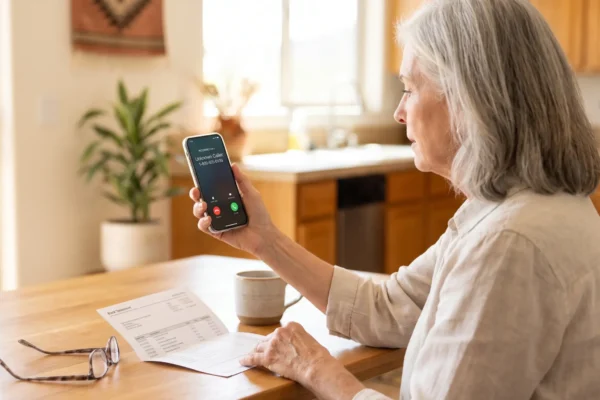
What Counts as Elder Financial Abuse?
The NIA reports that each year hundreds of thousands of adults over 60 are abused, neglected, or financially exploited. It also notes this can happen anywhere the person lives: their own home, a relative’s home, an assisted living facility, or a nursing home.
That range matters, because families usually watch for one shape of the problem. A scam call sounds like the real risk. A relative who already has the debit card does not.
What Are the Warning Signs of Elder Financial Abuse?
Signs in the Accounts
- Sudden changes in bank accounts or banking habits, including a large withdrawal made while someone else is along for the trip
- An extra name added to the older adult’s bank signature card
- Unauthorized ATM withdrawals using the older adult’s card
- Abrupt changes to a will or other financial documents
- Funds or valuable possessions that disappear with no explanation
- Unpaid bills or poor care even though the money is there
- A forged signature on a transaction or on the title to something they own
One of these on its own may have a simple answer. Several at once usually do not, especially when the person cannot say where the money went.
Signs in the Person
The CFPB also points to sudden shifts in spending or saving: withdrawals with no explanation, large amounts wired out, and heavy ATM use. Another sign on its list is a person who is no longer allowed to speak for themselves, because someone else answers and seems to be running the decisions.
The common thread is control. Whether the pressure comes from a voice on the phone or a person in the kitchen, your parents end up making money decisions they cannot explain to anyone.
Which Senior Scams Target Older Adults Most Often?
Citing the FBI’s Internet Crime Complaint Center 2025 Internet Crime Report, NCOA says adults age 60 and older filed more than 201,000 complaints with reported losses above $7.7 billion – roughly 37% higher than the year before.
Here is how NCOA sorts the five top senior fraud complaints, by what the scammer is after and the signal that gives it away.
| Scam | What Scammers Want | Biggest Warning Sign |
|---|---|---|
| Grandparent | Money | A family emergency |
| Tech support | Remote access to the device | A pop-up warning |
| Government | Personal information | Threats |
| Romance | Money | An emotional relationship |
| Investment | Cryptocurrency | Guaranteed returns |
How the Grandparent Scam Usually Opens
Two details give it away. The caller begs the person not to tell anyone, and the payment has to be a gift card or a wire transfer. NCOA notes those methods often need no ID to collect, which is why victims rarely see the money again, and some have had a fake courier show up at the door.
AI has made the voice part harder to catch. NCOA notes that con artists can now clone a real relative’s voice and use that recording in these calls.
Why Do Scams Work So Well on Older Adults?
Urgency and Secrecy Do the Work
Secrecy comes next. When a fake grandchild begs your parents not to tell anyone, the script is cutting out the one family member who would have asked a hard question. A request for silence is worth more attention than the story itself.
Who Loses the Most
Investment scams drove much of the recent growth. That same FTC report says reported losses from investment scams among older adults jumped 42% in 2025 to more than $1 billion, with many of those approaches starting on social media.
What If the Person Taking the Money Is Family or a Caregiver?
Red Flags Inside the Family
Power of attorney gets misused the same way. A document meant to help with bills can also move money, and the Justice Department flags the sudden appearance of previously uninvolved relatives claiming rights to a parent’s property or possessions.
When Care Starts Slipping
How Can You Protect a Parent's Money Before Something Goes Wrong?
Name a Trusted Contact Person
It does not hand over control, which is what most parents are worried about. FINRA is clear that a trusted contact cannot trade or make decisions on the account and is not a power of attorney, legal guardian, trustee, or executor.
Know That a Firm Can Press Pause
Read the Statements Together
Timing helps too. Money decisions get harder as thinking changes, which is why many families look at the early signs of dementia and the paperwork in the same season rather than years apart.
How Do You Bring It Up Without Starting a Fight?
Independence is the real subject underneath. The same thing happens around taking the car keys from an aging parent, where the fear of losing freedom shuts the conversation down faster than any fact does.
Shame is the other wall. NCOA says plainly that there is nothing to be ashamed of if this happens to you, and saying that out loud makes it far easier for a parent to admit what already went wrong.
What Should You Do If the Money Is Already Gone?
Reporting does more than chase one loss. NCOA notes that many people assume it will not matter, while sharing what happened helps authorities spot patterns and argue for stronger consumer protections.
Then look at the whole picture, not just the account. The NIA points out that mistreatment of older adults can come from caregivers and health care providers as well as strangers, so one loss is a reason to look at who else has access.
How Can a Doctor Help Catch This Early?
As a geriatric doctor, I look at thinking and memory as part of a regular visit, not as a separate appointment. A parent who is struggling to follow a conversation about money needs something different from a fraud alert, and that difference is worth sorting out early.
If something about a parent’s money decisions has been nagging at you, it belongs on the list for their next visit. Dr. Cook sees patients at home across Scottsdale, Paradise Valley, Fountain Hills, Chandler, and the Phoenix East Valley, and you can book a home visit and raise it alongside everything else.
Frequently Asked Questions
Can a brokerage firm stop a suspicious withdrawal?
Yes, for a limited time. FINRA says a firm may place a temporary hold on a transaction or disbursement for up to 15 business days when it suspects exploitation of an investor 65 or older. The firm has to investigate and try to notify the investor and the trusted contact.
Does elder financial abuse only happen over the phone or online?
No. The National Institute on Aging notes it can happen in the older person’s own home, a relative’s home, an assisted living facility, or a nursing home, and the person responsible may be a family member, friend, caregiver, or health care provider.
Why do scammers ask for gift cards or wire transfers?
Because those payments are hard to trace and usually impossible to claw back. NCOA notes that collecting them often does not require ID, so once the card numbers are read out loud, the money is gone.
Can a scammer fake a relative’s voice on the phone?
Yes. NCOA notes that con artists can clone the voices of real relatives with AI tools and use them in grandparent-style calls. A familiar voice is no longer proof of who is calling, which is why a callback to a known number matters.
What is a bank signature card, and why does a new name on it matter?
It is the bank’s record of who is authorized to sign on an account. The Justice Department lists an added name on an older adult’s signature card as a red flag, because it gives someone else access without any transfer of ownership or any paperwork a family would notice.
What is the difference between elder fraud and exploitation by a family member?
Fraud comes from outside and usually arrives as a single pressured event. Exploitation by someone close tends to build slowly through access: a card, a signature, a document. The second kind is harder to spot because nothing about it looks like a scam.
Sources Used
FTC Issues Annual Report to Congress on Agency’s Actions to Protect Older Adults – Federal Trade Commission (2026)
How can I tell if a friend, neighbor, or family member is a victim of financial exploitation? – Consumer Financial Protection Bureau (2025)
Protecting Older Investors From Financial Exploitation – FINRA (2025)
Red Flags of Elder Abuse – U.S. Department of Justice, Elder Justice Initiative (2023)
The Top 5 Financial Scams Targeting Older Adults – National Council on Aging (2026)