The information provided in this article is for educational and informational purposes only and is not intended as medical advice, diagnosis, or treatment.
Families rarely ask when to stop driving out of nowhere. Something happened: a fresh dent, a missed exit, a call from a neighbor.
No birthday settles this. Older Adult Drivers data published by the CDC in 2026 shows that in 2022 about 9,100 older adults died in traffic crashes and more than 270,000 were treated in emergency departments. The same page points out that older adults, as a group, drive more carefully than younger ones. So the question is about one person and one pattern.
As a geriatric doctor, I usually meet this question after a scare, when everyone at the table is upset and nobody has slept. It goes better earlier, with a short list of things to watch for and a plan for rides that exists before the keys come up at all.
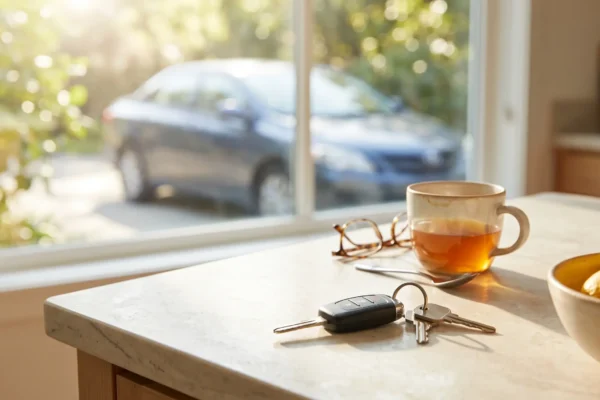
How Do You Know When It Is Time to Stop Driving?
One wrong turn means nothing. Three in a month on roads a person has driven for thirty years means something. The signals that matter are the ones that repeat, and the ones a person cannot explain afterward.
Red Flags You Can See From the Passenger Seat
- New dents or scrapes on the car, the garage door or the mailbox
- Near misses, or crashes a parent describes as somebody else’s fault
- Two or more tickets, warnings or small accidents in a short span
- An insurance premium that went up because of driving
- Getting lost on familiar roads, or a simple errand that takes two hours
- Drifting out of the lane, or trouble parking in a space that used to be easy
- Driving far too slowly, or stopping in traffic for no clear reason
- Missing stop signs and lights, or growing agitated behind the wheel
- Mixing up the brake and the gas pedal, even once
That last one belongs in its own category. Confusing the pedals is the item on the list that turns a slow conversation into an urgent one, and it should go to a clinician the same week.
Health Changes That Show Up Behind the Wheel
Driving and older adults, reviewed by MedlinePlus in 2026, groups the usual causes: stiff joints that make it hard to grip the wheel or check a blind spot, reaction times that have slowed, glare and poor night vision, hearing loss that hides a horn or a siren, dementia, and side effects from medicine.
Each of those has its own fix, and several of them are reversible. An out-of-date prescription for glasses is not the same problem as dementia, and it is worth separating the two before anyone talks about selling a car. A vision check after 60 and a review of everything in the cabinet, including what gets taken for sleep, are the cheapest places to start.
Medicine deserves a closer look than it usually gets. Drowsiness and slower reflexes build up quietly when several prescriptions overlap, which is the heart of polypharmacy in older adults. A pharmacist or physician can go through the whole list in one sitting and often finds something to simplify.
The table below pairs each common change with what it makes harder in the car and the first step that usually helps. None of it replaces an exam, and the right order depends on the person.
| Change With Age | What It Makes Harder in the Car | A Sensible First Step |
|---|---|---|
| Stiff joints, weaker grip | Turning the wheel quickly, checking the blind spot | Ask about joint care and hand controls |
| Slower reaction time | Braking in time, reacting to a surprise | Avoid highways and rush hour |
| Glare and weak night vision | Reading signs, driving after dark | Yearly eye exam, daylight driving only |
| Hearing loss | Noticing horns, sirens, engine trouble | Hearing check, wear aids while driving |
| Medicine side effects | Staying alert, judging distance | Full medicine review with a clinician |
| Memory and judgment changes | Route finding, decisions in traffic | Memory evaluation before any road test |
Why Does Dementia and Driving Need a Different Answer?
Dementia and driving, reviewed by MedlinePlus in 2026, is direct about the consequence: a person with signs of dementia should be tested regularly, and retested about six months later even after passing. The same page notes that people with severe dementia should not drive at all.
That is why a parent can say truthfully that the driving is fine while the car tells a different story. The insight is gone, so the family has to do the observing. It helps to know which changes point that way, which is the subject of the 10 early signs of dementia worth checking.
Plenty of forgetfulness is not dementia at all, and that distinction changes what happens next. Normal age-related memory loss compared with dementia follows a different pattern, and a memory evaluation is what separates them. Early dementia does not always mean the keys go today, though it does mean a plan and a date to look again.
What Does a Driving Evaluation for Seniors Involve?
A driver rehabilitation specialist, usually an occupational therapist, looks at vision, strength, movement and thinking first, then watches an actual drive. What comes back is not only a pass or a fail. It often lists conditions a person can keep driving under, such as daytime only, familiar routes, or no freeway.
The National Institute on Aging points families to the national database of driving specialists kept by the American Occupational Therapy Association, and notes that a state licensing office or a clinician can also recommend someone. Fees usually apply, and they vary a great deal by program and by region.
For many families this is the step that ends the argument. The result arrives from someone with no stake in the outcome, which is much easier to accept than a son saying the same thing over Sunday dinner.
Is There a DMV Test for Seniors Over 70?
Driving Safety and Alzheimer’s Disease, reviewed by the National Institute on Aging in 2024, lays out the range. Some states revoke a license automatically once dementia is diagnosed. Others let the person take a test and keep driving if they pass. Many require a retest whenever there is reason to think someone can no longer drive safely.
Who can give the state that reason is the part worth knowing. Reports can come from law enforcement, from medical staff, from concerned citizens and from family members. A few states go further and require physicians to report a dementia diagnosis to the motor vehicle department.
Renewal rules for older drivers also differ by state, including how often a license has to be renewed in person and whether a vision screening is part of it. Your own motor vehicle department is the only reliable place to confirm what applies where your parents live.
How Do You Take the Car Keys Without a Family Fight?
Driving stands for independence, so an argument about driving becomes an argument about being treated like a child. Talking about eyesight, reaction time or medicine keeps the subject on something fixable. Saying someone is too old to drive guarantees a closed door.
Start With Limits Rather Than a Full Stop
At the same time, shrink the reasons to drive at all without shrinking the person’s week. Groceries, meals and prescriptions can be delivered. Some barbers and hairdressers make house calls. Family visits that include an outing cover the trips that mattered most.
What a Doctor Can Add to the Conversation
The National Institute on Aging suggests asking the person’s doctor to deliver the message directly, including writing “Do not drive” on a prescription pad so the instruction exists on paper. A note like that does not cancel a license by itself, but it moves the decision off the family and onto a medical record, and it gives everyone something to point back to next week when the conversation starts over.
If a Parent Keeps Driving Anyway
- Keep the keys somewhere the person does not go
- Have the keys disabled so the car will not start
- Have the car itself disabled by a mechanic
- Move the car to a relative’s driveway or a storage lot
- Sell the car
Each of these works better paired with transport that shows up reliably. Taking away a car and leaving someone stranded invites the whole fight back in a week, and it tends to produce a spare key nobody knew about.
Who Is Legally Responsible If an Unsafe Driver Crashes?
Licensing sits with the state, which is why a documented report to the motor vehicle department matters more than a verbal warning. In many states a re-examination can be triggered by a report from police, medical staff, a family member or a member of the public, and in a few states a physician is required to report a dementia diagnosis.
Questions about liability for an adult child who owns the car, insures it or hands over the keys are genuinely legal questions, and the answers differ sharply from state to state. An attorney licensed where your parents live is the right person to ask, and that call is worth making before a crash rather than after one.
Life After the Car Keys in Scottsdale and the East Valley
Associations between Driving Cessation and Mental Health among Rural and Urban Older Adults, published in 2024, used national Health and Retirement Study data from 5,650 adults aged 65 and over. About 6% had stopped driving and roughly 22% had cut back to nearby trips only, and both groups reported more depressive symptoms than people still driving freely.
The lesson is not that a parent should keep driving. It is that the weeks after the keys go need as much attention as the keys themselves. Isolation does real damage, and it arrives quietly.
Across Scottsdale, Paradise Valley, Fountain Hills, Chandler and the East Valley, that usually means stacking several options rather than finding one. City and county dial-a-ride programs cover appointments. Rideshare handles the unplanned trips, and a grandchild can set it up on a phone. A local Area Agency on Aging can list what exists in a specific zip code, and the Eldercare Locator at 800-677-1116 is the national starting point.
Sometimes this conversation turns out to be about more than driving. When meals, medicine and housekeeping are also slipping, the question underneath is whether it is time for assisted living, and driving is simply the part the family notices first.
Where a Home Visit Fits
Vision, hearing, strength, balance, memory and the full list of medicines are all things a geriatric physician can go through in one unhurried home visit, and seeing someone in their own house shows things an office never does. Dr. Rebecca Cook visits patients at home and by video across the greater Phoenix area, which also means no one has to arrange a ride to the appointment that is about rides.
If the car has been on your mind for a while, a visit is a reasonable next step before anything gets decided. You can book an appointment and bring your notes, dates and all.
Frequently Asked Questions
Can a parent keep driving if they only go to the store and back?
Many people do exactly that for years, and a short, familiar daytime route is the safest kind of driving there is. The arrangement holds as long as the limits hold. It stops working once the person starts taking longer trips again or cannot remember the agreement.
Will a doctor’s note take a license away?
Not on its own. A note records a medical opinion and gives the family something concrete, while the license itself belongs to the state licensing agency. In some states a clinician’s report does start a formal review.
How much does a driving evaluation cost?
Fees vary widely by program and region, and they are usually paid out of pocket. Ask for the price and what the report includes when you book, since a clinical screening and a full on-road evaluation are priced differently.
Can someone outside the family report an unsafe driver?
Yes. In many states a report can come from police, medical staff or a member of the public, not only from relatives. That is one reason a neighbor’s comment about erratic driving is worth taking seriously rather than dismissing.
Should I ride along to judge the driving myself?
It helps, as long as you sit quietly and watch instead of coaching. Ride on an ordinary errand rather than a route chosen for the occasion, and write down what you saw the same day while the details are still exact.
What if a parent agrees to stop and then starts driving again?
Treat it as part of the process rather than a betrayal, especially when memory is involved, since the decision itself may not have stuck. Put the agreement in writing, make the alternative rides easy, and if the car is still in the driveway, consider moving it.
Sources Used
Dementia and driving – MedlinePlus Medical Encyclopedia (2026)
Driving and older adults – MedlinePlus Medical Encyclopedia (2026)
Driving Safety and Alzheimer’s Disease – National Institute on Aging (2024)
Older Adult Drivers – Centers for Disease Control and Prevention (2026)
Driving Evaluation | Services & Related Specialties | Byrd Alzheimer’s Institute – USF Health Care