Mobile imaging services in Arizona bring the X-ray machine to the bedside. The harder part is everything around it: who orders the scan, and who acts on the result.
The order is the first gate, and it is not optional. Medicare covers medically necessary diagnostic X-rays under Part B, and your treating doctor or other health care provider has to order them (X-rays). Nobody can call a mobile X-ray company and book a scan the way you would book a haircut.
As a geriatric doctor who sees patients at home, I find this is where most families get stuck. They have already discovered that home X-rays exist. What they cannot find is the person who will order one, choose the company, read the result in the context of everything else going on, and then change the plan accordingly.
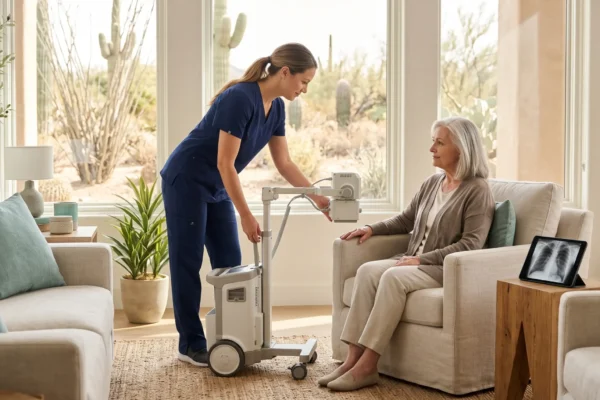
Who Orders a Mobile X-Ray, and How Does the Visit Happen?
The Order Comes First
What the Visit Looks Like
The whole appointment is short. In a clinic, a chest X-ray takes roughly fifteen minutes from positioning to confirming the images are usable, and a home visit runs on the same clock once the equipment is set up. For someone with dementia, that short window is the whole argument for staying home.
Where the Images Go
What Is the Difference Between Portable and Mobile X-Ray Units?
Fixed equipment lives in a radiology suite, with the tube mounted on a wall or suspended over a table. Compact, portable machines can instead be taken to the patient at the bedside, with the tube on a flexible arm and the image plate placed under the person. That is the category every home X-ray falls into.
Within that category there is a real difference in size. Some units are wheeled machines that roll in on a cart, which is what most people picture. Others are handheld generators light enough to carry in a bag, which is a newer design. Both produce digital images that upload for reading the same way.
So when a company advertises a mobile imaging unit and another advertises portable X-ray services, you are not looking at two different services. Ask what the unit is, whether the images are digital, and who reads them. Those three answers tell you more than the adjective in the company name.
Is a Home X-Ray as Good as One at the Hospital?
The numbers came out close. Mean agreement across 15 image-quality parameters was 87.2%, and the handheld images scored a median 9 out of 10 for overall quality against 8 for the facility machine. The authors concluded that the portable unit produced quality comparable to the machines used routinely in health facilities.
Two honest caveats belong with that number. The study was done in a tuberculosis screening program rather than in people’s homes, and the authors say a larger trial would be needed before calling handheld imaging equivalent for diagnosis. It supports the idea that image quality is not the weak link; it does not prove every home study equals every hospital study.
The part that genuinely does not change is who reads the image. A radiologist is a physician trained to supervise and interpret imaging exams, and that is who writes the report whether the picture was taken in a hospital bay or in a bedroom in Paradise Valley. The technologist operates the machine; the radiologist interprets it.
What Can and Cannot Be Done at Home?
Where Ultrasound Fits
What an X-Ray Will Not Show
The Short Version
| Test | Can it come to the home? | What it answers |
|---|---|---|
| Chest X-ray | Yes, at the bedside | First test for cough, fever, breathing trouble, or suspected pneumonia and fluid around the lungs. |
| Bone and joint X-ray | Yes, at the bedside | Checking for a fracture after a fall, often in a hip, wrist, shoulder, or spine. |
| Abdominal X-ray | Yes, at the bedside | Looking at bowel gas patterns and the position of tubes or devices. |
| Ultrasound, including Doppler | Yes, portable | Soft tissue, bladder volume, gallbladder, kidneys, and blood flow questions such as clots. No radiation. |
| Blood draws and urine tests | Yes, mobile phlebotomy | Routine monitoring, infection work-up, kidney and liver function, medication levels. |
| CT scan | No | Needs fixed equipment. Used when an X-ray is not enough, including suspected blood clots in the lungs. |
| MRI | No | Needs a shielded room and fixed equipment. Often the test for the inside of bones and joints. |
| Mammography and DEXA bone density | Usually no | Normally scheduled at a facility or a dedicated mobile unit rather than a home visit. |
What About Blood Draws and Lab Work at Home?
A phlebotomist comes to the house, draws the sample, and the laboratory runs it the same way it would for a sample collected in a clinic. In Scottsdale I order through GTI Laboratories, and how an in-home blood draw is arranged is set out on its own page. The sequence is what matters: the order goes out, the draw happens, the results come back to me, and the plan changes if they call for it.
Lab work is also where home monitoring earns its keep. Kidney function, electrolytes, and thyroid levels are the kind of numbers that decide whether a medication list is safe to leave alone, which is the heart of any review of too many medications. Skipping those draws because the drive is hard is how a quiet problem becomes a hospital admission.
Does Medicare Cover Mobile Imaging and Home Lab Work?
Door One: Part B, With No Homebound Requirement
Door Two: The Home Health Benefit, Where Homebound Does Apply
The gate has two more parts. A doctor or health care provider must see the patient in person, confirm that home health care is needed, and order it, and a Medicare-certified agency has to provide the care. Covered home health services cost you nothing, and leaving home occasionally for medical treatment or short absences does not break homebound status.
What Medicare Will Not Pay For
That last line is the one that surprises families most. The X-ray and the blood draw are covered services; the help getting your mother dressed afterward generally is not. Those are two separate conversations, and mixing them is how people end up with an unexpected invoice.
Who Reads the Result, and Who Decides What Happens Next?
A report that says mild patchy opacity at the left base is accurate and, on its own, not a plan. What turns it into one is the context: the medication list, the swallowing history, the three falls last winter, the weight that dropped four pounds since August, what the family can manage at home this week.
That is the work I do as a geriatric doctor, and it is deliberately unglamorous. I order the study, pick a provider I trust, read the radiologist’s report against everything else in the chart, and adjust treatment the same week rather than referring the family onward to find out for themselves. The wider version of that role is described in a guide to geriatric care coordination.
One practical consequence: ask who will call you with the result before the technologist arrives. If the answer is unclear, the imaging is being arranged without an owner, and an unowned result is the most common way a finding sits in a portal for three weeks.
When Is Mobile Imaging the Wrong Choice?
Sudden chest pain, trouble breathing, signs of a stroke, a head injury, a fall with an obvious deformity or an inability to bear weight, or a sudden change in alertness all belong with 911 and an emergency department. An X-ray in the living room is not the right answer to any of them, and waiting for one costs time that matters.
The gray zone is a fall that looked minor. Someone goes down, gets up, says they are fine, and the pain shows up the next day. That is exactly the case a home X-ray handles well, provided somebody has already checked for the warning signs that mean a trip to the emergency room instead (what to do right after a fall).
How This Works Across Scottsdale and the East Valley
Arizona adds its own reason to stay in. Moving a frail parent from an air-conditioned house to a hot car to a waiting room and back is hard in January and genuinely risky in July, and the trip itself is often the part that sets off a bad week rather than the test at the end of it.
It also works in assisted living, memory care, and skilled nursing settings, where staff can let the technologist in and I can review the report without anyone arranging transport. For families managing care from another state, that removes the single hardest logistical step.
If getting your parent to an imaging center has become the reason tests keep getting postponed, that is a solvable problem rather than a permanent one. You can book a home visit with Dr. Rebecca Cook and we can start with what actually needs answering.
Frequently Asked Questions
Can I order my own X-ray without seeing a doctor first?
Not for a Medicare-covered study. The order has to come from your treating doctor or another health care provider, which is also what keeps the study pointed at a specific clinical question rather than being a picture with no purpose.
How quickly can a mobile X-ray happen if it is urgent but not an emergency?
Same-day and next-day visits are often possible, and that is worth asking about when you call. Anything that cannot safely wait that long is an emergency department situation rather than a scheduling problem.
Does the technologist need anything from us before the visit?
Usually a clear path to the bed or chair, a spot to set up the equipment, and the medication list nearby. Remove jewelry and any metal objects near the area being imaged, since they interfere with the image.
Is the radiation from a home X-ray different from a hospital one?
No. A chest X-ray uses a very small dose of ionizing radiation, no radiation stays in the body afterward, and modern systems use controlled beams and dose-control methods to limit exposure to areas not being imaged.
What if the first test comes back unclear?
A follow-up exam is common and not a bad sign. Sometimes it means more views or a different technique; sometimes it means the question needs equipment that does not travel, and the trip to a facility becomes worth making.
Can a home visit replace the annual in-person checkup?
It can be the in-person checkup. A home visit is a face-to-face encounter, which is also why it can satisfy the in-person requirement that comes up when home health services need to be certified.
Sources Used
Chest X-ray – RadiologyInfo.org (RSNA and ACR) (2024)
Diagnostic laboratory tests – Medicare.gov
General Ultrasound – RadiologyInfo.org (RSNA and ACR) (2024)
Home health services – Medicare.gov
X-rays – Medicare.gov